


Structure payroll inputs for review
Organise attendance, leave, overtime and employee-change information into clear review queues while preserving source references and unresolved questions.
This proposed AI payroll and HR administration course helps Malaysian HR, payroll and manufacturing office teams organise routine records, exceptions and communications with careful human review. Examples use fictional or sanitised information; syllabus, tools and availability should be confirmed with AIGreen Plus.
Proposed course outline; tools, dates, format, duration and fees must be confirmed with AIGreen Plus.

AI payroll training Malaysia can help HR and payroll teams use AI to structure attendance records, prepare reviewable payroll checklists, draft employee communications and identify questions for follow-up. It does not make final pay, employment, statutory or compliance decisions: authorised payroll owners verify source data, current official guidance and every approved output.
This is a proposed training outline, not a confirmed schedule or a promise of commercial results. Use fictional or approved examples and keep decisions with the responsible people.
Learning objectives describe practice, not guaranteed business results.
Organise attendance, leave, overtime and employee-change information into clear review queues while preserving source references and unresolved questions.
Use AI-assisted drafts for onboarding checklists, internal notices, employee-query responses and recurring HR records without exposing unnecessary personal information.
Create human-reviewed checklists for anomalies, reconciliations, approvals and handoffs, keeping final pay and employment decisions with authorised personnel.
Define permitted use, access boundaries, reviewer roles, escalation steps and a small pilot for payroll or HR administration without promising savings or compliance outcomes.
Prompt → Check → Revise → Review
Use AI to support suitable tasks. Manufacturing, quality, safety and business decisions remain with the people responsible.
Course visuals are AI-created fictional scenes; people and facilities do not depict actual AIGreen Plus staff, learners or client events.
A payroll administrator uses a fictional attendance, leave and employee-change set to organise missing inputs and unusual entries into a review queue. The payroll owner checks every item against approved records before any payroll action.
An operations coordinator prepares questions from a sanitised Malaysian manufacturing shift log, separating reported hours from unresolved policy questions. Supervisors and HR confirm the records; AI does not decide payable time or entitlement.
An HR team drafts a fictional onboarding checklist and a neutral response to a mock payslip query. They remove unnecessary personal data, use approved wording and obtain HR or payroll approval before sharing.
Examples are fictional or sanitised proposals, not AIGreen Plus client case studies or verified results.
These are AIGreen Plus's proposed design priorities for this course, not an independent competitor comparison or a claim that other providers lack similar content. Confirm the syllabus, tools, delivery format and availability with AIGreen Plus.
| Potential point of difference | AIGreen Plus's approach | Why it may matter to a factory |
|---|---|---|
| Payroll-specific workflow practice | The proposed lessons follow payroll inputs, exception review, reconciliation and employee communications rather than generic productivity examples. | Participants can relate AI assistance to recurring HR and payroll handoffs while keeping final decisions with authorised owners. |
| Manufacturing shift context | Fictional scenarios include production attendance, leave and overtime questions that connect operations coordinators with HR and payroll. | Teams can practise tracing timekeeping information across office and shop-floor roles without using live employee records. |
| Reviewable administration by design | Each exercise asks learners to preserve sources, surface assumptions, document exceptions and obtain human approval before circulation or action. | The approach supports controlled drafting and analysis instead of unattended payroll processing or employee decision-making. |
| Responsible local scoping | The proposed course prompts teams to check current official sources, organisational policy, data boundaries and vendor access with the appropriate owners. | HR teams can discuss a practical pilot while avoiding unsupported claims about compliance, features, access or business results. |
On small screens, scroll horizontally inside the table to compare all three columns.
Eight proposed modules are shown in a structured table for easy review. Confirm the final syllabus, depth, tools, duration and delivery format with AIGreen Plus.
On small screens, scroll horizontally inside the course outline table to see every column.
| Module | Focus | Key points | Practice exercise |
|---|---|---|---|
| 01Responsible AI for Payroll and HR | Set a safe scope for AI assistance in payroll and HR administration and distinguish drafting support from accountable decisions. |
| Review a fictional payroll-team request, remove unnecessary employee details, label decision points and write an approval path before drafting anything. |
| 02Payroll Data Foundations and Source Checks | Prepare reliable, traceable inputs from employee master data, attendance, leave and approved payroll records. |
| Use a sanitised employee-change and attendance extract to build a source-check table, marking each field as verified, missing or requiring owner confirmation. |
| 03Prompting for Payroll Reviewable Drafts | Design precise prompts that ask AI to organise payroll work without treating generated calculations or conclusions as final. |
| Turn a vague month-end payroll request into a structured prompt using fictional data, then compare the draft exception list with a manually checked source sheet. |
| 04Attendance, Leave and Overtime Exceptions | Support review of shift-based attendance, leave balances and overtime inputs while keeping policy interpretation with authorised owners. |
| Analyse a mock Malaysian manufacturing shift log with leave and overtime anomalies, produce questions for supervisors and avoid deciding payable hours. |
| 05Employee Lifecycle and HR Records | Use AI to organise onboarding, employee changes, transfers and offboarding administration with controlled access and clear ownership. |
| Create a fictional onboarding and transfer checklist for a production employee, then mark which items require HR, payroll, IT or supervisor confirmation. |
| 06Payroll Communications and Employee Queries | Draft clear, respectful payroll and HR communications that explain next steps without inventing policy, entitlement or personal details. |
| Rewrite a sanitised employee query about a payslip discrepancy into a neutral response that states known facts, requests evidence and assigns human follow-up. |
| 07Reconciliation, Audit Support and Current References | Create reviewable payroll-control documentation while treating AI as analysis support, not a compliance or statutory authority. |
| From fictional payroll-register and approval summaries, draft a reconciliation checklist, identify mismatches and list questions for the payroll owner to verify against current official guidance. |
| 08Payroll-data pilot review and approval controls | Translate learning into a controlled payroll or HR pilot with defined safeguards, evaluation questions and escalation routes. |
| Draft a one-page pilot brief for an HR query-triage or payroll exception task, including scope, safeguards, responsible reviewer, stop conditions and feedback questions. |
It is a proposed course on payroll data preparation, attendance and leave exceptions, HR lifecycle records, employee communications, reconciliation support and responsible AI governance. Confirm the final syllabus and scope with AIGreen Plus.
It suits HR and payroll administrators, HR managers, finance or office staff, operations coordinators and supervisors who provide attendance or employee-change inputs in Malaysian organisations.
No. AI may help organise inputs or flag questions, but authorised payroll owners must verify calculations, policies, employee records and approvals before any payroll decision or payment process.
Use fictional or sanitised examples and minimise personal information. Do not enter live salary, identity or confidential records unless the organisation has explicitly approved the tool, purpose, access and retention arrangements.
It can use current official references as review prompts, but AI is documentation and analysis support only. Authorised HR or payroll owners must check the latest official sources and obtain professional advice where needed.
Teams can practise organising shift attendance, leave, overtime and employee-change questions for HR and payroll review. Fictional scenarios do not replace timekeeping controls, supervisor confirmation or payroll approval.
No particular vendor or plan is promised. Tool choices, account access, current features and organisational approval should be verified with AIGreen Plus and the relevant software owner before delivery.
No. The syllabus, tools, availability, language and delivery arrangements are proposed and should be confirmed with AIGreen Plus for the organisation's roles, policies and approved environment.
They are not specified in this record. Confirm duration, fees, certificate arrangements and any HRD Corp eligibility directly with AIGreen Plus before planning participation or a claim.
Share participant roles, payroll or HR priorities, approved tools and data restrictions with AIGreen Plus. Request confirmation of the syllabus, safeguards and commercial details, and do not send live employee records.
How can a Malaysian HR team pilot AI for payroll exception review without handing over payroll decisions?
Use AI only with fictional or sanitised attendance, leave, overtime and employee-change records to test a review queue and neutral draft communications. Set access, source-reference, escalation and approval boundaries first. A competent payroll owner verifies every output against approved records and current official references, then decides whether to continue, revise or stop.
A practical course proposal. Select approved tools and sample data under your organisation's policy; keep operational, safety, quality and other authorised decisions with the responsible people.

Select a bounded administrative task using sanitised data.

Define approved sources, privacy boundaries and approval gates.

Create traceable prompts for reviews and neutral communications.
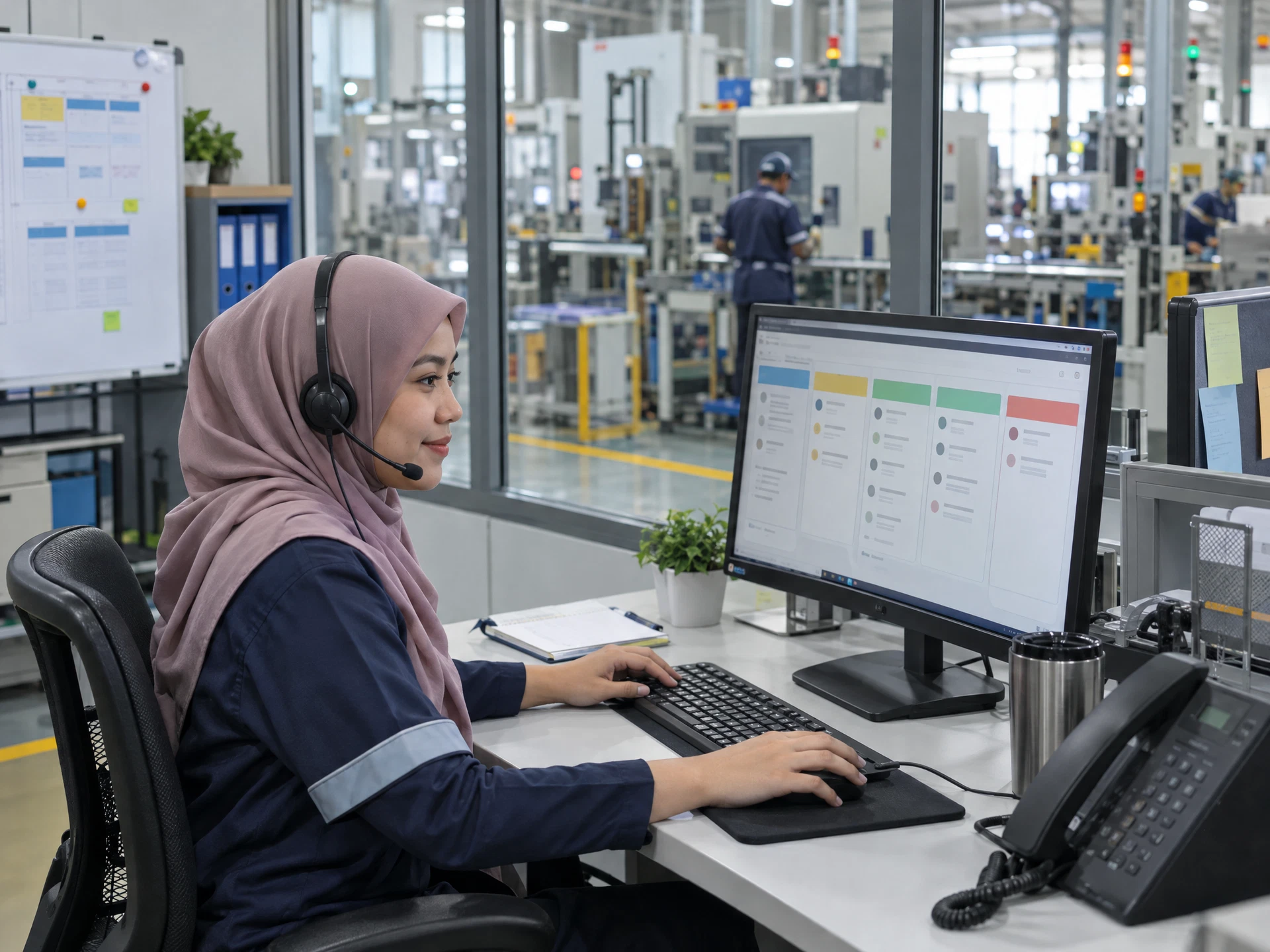
Test sanitised cases and verify every generated draft.

Pilot briefly, assess controls and decide next steps.
Use the materials with a competent workplace owner and the appropriate approvals.
The five-stage flow uses AI-created fictional scenes; the people, equipment, interfaces and facilities are not actual AIGreen Plus staff, learners, clients or factories. Course images are category-specific examples. Pending assets are labelled in progress; unavailable artwork is suppressed rather than replaced with unrelated imagery.
Share the course title, participant roles and learning priorities. AIGreen Plus will confirm syllabus, tools, availability, delivery language, format and quotation.
Do not send confidential production data, account details or personal information in an enquiry.
