


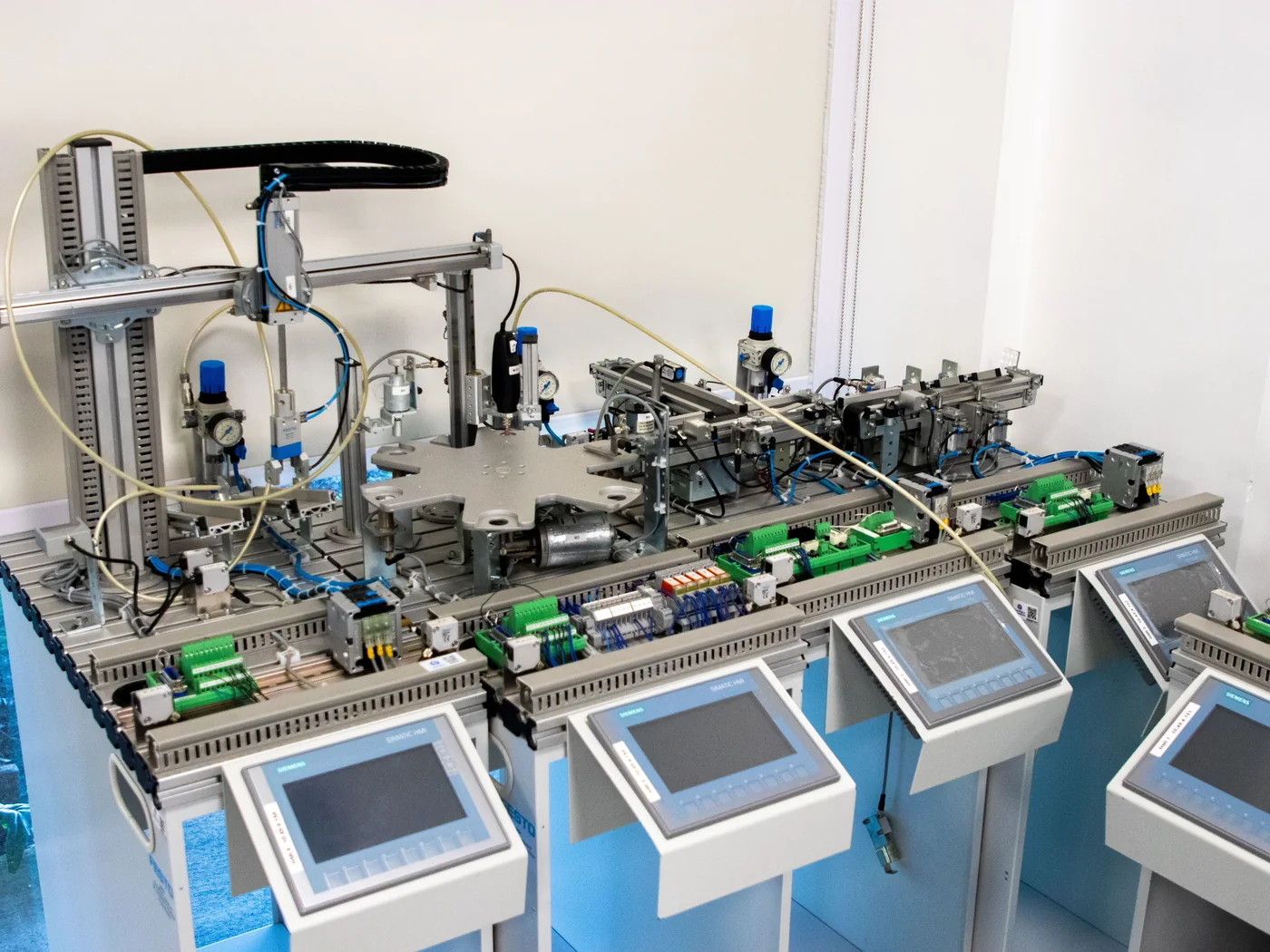
Practical training starts with a real factory task.
AI for manufacturing training teaches factory employees to use approved AI tools for specific work tasks—such as drafting first-pass summaries, organising maintenance notes or reviewing quality records—while trained staff verify outputs and retain control of production, safety and compliance decisions.
Use examples from operations, QA/QC, warehouse, maintenance, purchasing, HR, safety and learning teams.
Use permitted data and require the responsible process owner to check AI-assisted outputs.
Compare like-for-like time, correction effort and output quality; do not assume a saving.
A useful AI training programme for manufacturers begins with work people already do. Teams can learn where an approved AI assistant may help draft, summarise or organise information, and where a person must still check every source and decision.
Training can be adapted for Malaysian factory operations, QA/QC, warehouse, maintenance, purchasing, HR, safety and learning teams. Exercises should use approved or sanitised examples rather than exposing confidential production, supplier, employee or customer records.
The goal is practical capability, not an automatic promise of higher output or lower staffing. A manufacturer should define one task, agree a fair baseline, review the results and decide whether the workflow is safe and useful to continue.
What should AI training for manufacturing cover?
A grounded course covers task selection, approved tools and data boundaries, clear prompts, source checking, human approval and a simple way to measure the same task before and after practice. It also makes clear that AI drafts do not approve product, change machine settings, replace safety controls or make purchasing decisions.
Where manufacturing teams can start
These are training exercises, not claims of completed client projects. Keep each task within approved data and process controls.
| Team | Training exercise | Human checkpoint |
|---|---|---|
| Operations & production | Draft a shift-handover summary from approved notes or organise downtime entries. | A supervisor verifies the source, time period, event codes and production context. |
| QA/QC | Group sanitised defect descriptions or prepare a first-pass quality-report outline. | QA confirms the inspection method, sample, defect definition and any proposed action. |
| Warehouse & purchasing | Prepare a stock-exception list or compare fields from supplier quotations. | A planner or buyer checks physical balances, lead times, specification and commercial terms. |
| Maintenance | Summarise approved historical work-order notes for a maintenance review. | Qualified maintenance staff verify asset history and decide whether further inspection is needed. |
| HR, safety & learning | Draft a role-specific checklist or training outline from approved internal material. | The relevant owner checks current policy, hazard controls, responsibilities and document approval. |
A practical five-step training workflow.
Choose one bounded task
Agree the task, process owner, expected output and where the activity starts and ends.
Check tools and data
Use only organisation-approved tools and inputs. Remove personal, customer, supplier or sensitive production details unless use is explicitly permitted.
Practise a clear workflow
Give the assistant a specific role, approved source material, output format and limits; keep a record of the prompt and source used.
Verify every draft
Compare the response with source records, correct unsupported statements and have the authorised person approve anything used at work.
Measure and decide
Repeat the same task under comparable conditions, review time and quality evidence, then decide to adopt, revise or stop the workflow.
Connect AI learning with controlled workplace use
Use this cycle to connect AI training with implementation. Each stage creates evidence for the next, so learning can lead to a controlled factory task—not only a slide deck.
Define a bounded task
Name the process owner, expected output, limits and a comparable starting baseline.
Approve tools and data
Confirm permitted tools, information boundaries, access and security requirements before practice.
Design the AI-assisted workflow
Specify the source, prompt, output format, exclusions and when to stop or escalate.
Verify every output
Check claims and figures against source records; record corrections and require the authorised person to approve use.
Run a controlled workplace pilot
Repeat the same task under comparable conditions and record time, rework, quality checks and exceptions.
Evaluate and improve
Decide to adopt, revise or stop; update the work instructions and feed lessons into the next task.
Suggested AI-training-to-implementation cycle: scope the task, approve inputs, design, verify, pilot and improve.
A suggested eight-module manufacturing AI workshop
Use this outline as a planning guide, not a fixed course duration or a promise of included deliverables. Discuss the chosen course, participant experience, exercises and available tools with AIGreen Plus before booking.
| Module | What the team practises | Suggested learning output |
|---|---|---|
| 01 / AI at work | Distinguish drafting and analysis support from machine control, quality release and safety decisions. | A list of permitted tasks and actions that remain outside the exercise. |
| 02 / Task selection | Choose a repeatable task with a process owner, clear inputs and a reviewable output. | A task scope and baseline worksheet. |
| 03 / Approved data | Identify confidential fields, access limits and sanitisation needs before using any AI assistant. | An approved or sanitised practice dataset. |
| 04 / Prompt design | Specify the task, source, constraints and output format; ask the tool to flag missing information. | A reusable prompt with explicit boundaries. |
| 05 / Reports and spreadsheets | Combine visible spreadsheet checks with an AI-assisted explanation of checked records. | A draft report linked to source rows and calculations. |
| 06 / Department exercise | Practise a production, quality, warehouse, purchasing, maintenance or support-team scenario. | A reviewed output relevant to the participant's role. |
| 07 / Quality and approval | Check omissions, unsupported statements, figures and document versions before accepting an output. | A human-review checklist and exception log. |
| 08 / Workplace follow-through | Agree who will test the workflow after training and how the team will assess time and quality. | An owned pilot plan with a review date. |
Which AI tools should a factory team learn?
Start with the tools your organisation permits. ChatGPT, Microsoft Copilot or Gemini may be considered for language-based exercises, alongside Excel for transparent calculations. Available features, account plans and data controls differ; training should use the actual approved environment, not assume every participant has the same access.
A sensible exercise asks the AI assistant to explain a checked spreadsheet or draft a summary from a supplied record. Keep calculations visible and source-linked. Do not ask it to invent a missing downtime cause, supplier charge or inspection result, and do not treat fluent writing as proof that an answer is correct.
Training first, system automation only after assessment
AI training develops employee capability. AI workflow automation connects tasks or systems under a separately defined implementation scope. On-the-job learning helps employees practise at work. These approaches can support each other, but a training exercise alone does not create a validated factory monitoring system.
For example, preparing a draft maintenance summary from historical records is a suitable bounded exercise. Connecting that summary to a machine controller or issuing a maintenance instruction requires a different engineering, cybersecurity and safety assessment. Agree the boundary before the training begins.
A suggested 30–60–90-day workplace follow-through plan
Treat this as an adjustable pilot sequence, not a guaranteed delivery schedule. The process owner can shorten, extend or stop it if data quality, workload or risk calls for a different approach.
| Review point | Team activity | Decision evidence |
|---|---|---|
| First 30 days / establish | Choose one task, approve tools and data, record the baseline and rehearse the review steps. | Task scope, approved input set and baseline records. |
| By 60 days / test | Repeat the workflow on a controlled sample and include the time spent checking and correcting drafts. | Output versions, time logs, corrections and review exceptions. |
| By 90 days / decide | Review the evidence with the process owner. Adopt, revise or stop the workflow before wider use. | An approval decision, updated instructions and an owner for ongoing checks. |
How to choose AI training for your Malaysian factory
A manufacturer in Selangor, Penang, Johor, Sabah or elsewhere in Malaysia should evaluate the fit with its work, not only the software named in the course title. Ask which department-specific exercises are included, what data can be used, who checks the outputs and what participants can practise after the session.
Before booking, confirm the course scope, fee, duration, delivery arrangements, language, software access and any follow-up support. If funding matters, confirm the exact course's HRD Corp eligibility and the applicable employer and grant conditions; a provider badge alone does not establish that every course or employer is eligible.
Responsible AI use belongs in the learning plan
Malaysia's national AI governance page lists voluntary guidance, including the National Guidelines on AI Governance and Ethics and the AI Code of Ethics. These resources offer context for organisational AI use; they are not proof that a factory has met every applicable legal or customer requirement.
For a practical exercise, name the task owner, use approved information, keep a record of the source and output, and define when a person must stop or escalate an uncertain result. NIST's Generative AI Profile is a voluntary companion resource for organisations considering trustworthiness in AI use and evaluation. Neither reading a framework nor attending a course certifies a factory or guarantees compliance.
Malaysia AI governance resources · NIST Generative AI Profile
Define what a pilot should measure.
The methods below describe evidence to collect and review. They are not reported client results or guaranteed improvements.
| Measure | Definition / method | Evidence source | Reviewer |
|---|---|---|---|
| Task completion time | Compare active staff time for the same task, scope and sample before and during the exercise. | Agreed baseline and task time log | Process owner |
| Output accuracy and rework | Check a defined sample against source records and record corrections, unsupported details and omissions. | Review checklist, source references and output versions | QA or relevant function lead |
| Human-review completion | Record whether required review occurred and whether exceptions were resolved before an output was used. | Approval or exception log for the agreed pilot scope | Supervisor or control owner |
Explore AIGreen Plus AI training for manufacturing.
Tell AIGreen Plus which department and repeatable task you want to improve. Explore the training catalogue, then discuss a suitable course and practical exercise for your team. This is a proposed learning approach, not a completed customer engagement or a guarantee of business results.
View AI Training for ManufacturingFrequently asked questions.
Direct answers about the scope and responsible use of this training topic.
What is AI for manufacturing training?
It is practical instruction that helps factory employees use approved AI tools for bounded work tasks such as drafting summaries or organising records, with people checking sources and retaining decision authority.
Who should attend AI training for manufacturing in Malaysia?
Depending on the selected task, participants may include operations, production, QA/QC, warehouse, maintenance, purchasing, HR, safety and learning teams. A process owner should help define the exercise.
Do factory employees need coding skills to attend?
Not for introductory, task-based exercises with approved AI tools. Technical integration or model development is a separate scope and may require specialist skills.
What will participants practise?
Teams can practise drafting or checking a report, summarising approved notes, organising records or creating a first-pass checklist. The exact exercise should match the role, permitted tools and available data.
Can employees upload factory, customer or staff data to a public AI tool?
Only if the organisation has approved that tool and data use. Follow internal privacy, security, confidentiality, access and retention rules; use sanitised examples when approval is unclear.
Can AI approve quality decisions or control manufacturing machinery?
This training guide does not recommend autonomous product release, safety approval or machine control. Any system connection requires separate engineering, cybersecurity, operational and safety review, with appropriate human authority.
How can a manufacturer measure whether AI training helped?
Define the task and baseline first. Compare like-for-like completion time, output accuracy, correction effort and required human review. Results vary by process, data, tools and implementation; no saving is guaranteed.
What is a sensible first step for a factory AI training programme?
Choose one repeatable task with a willing process owner. Agree the permitted data, tool, review steps and baseline before training, then use the evidence to decide what to improve next.
Is every AI manufacturing course HRD Corp claimable?
Do not assume this from a provider badge alone. Confirm the exact course's eligibility, your employer's position and the applicable grant and approval conditions before booking or budgeting for a claim.
Does attending AI training guarantee productivity gains or certification?
No. Training supports practical skills, but measurable results depend on the task, data, tools, review and workplace implementation. It does not guarantee productivity improvements, headcount reductions or certification.
Further reading
These resources offer additional context on responsible AI use and governance.
